Free Tools
Five interactive tools built for homeowners planning a generator installation — from sizing through inspection day.
Generator Size Calculator
Select your appliances, get a kW recommendation, matching models with noise ratings, and permit implications for your size.
Installation Cost Estimator
Full itemized cost breakdown — unit, labor, permits, gas line, concrete pad — by generator size and region. Spot-check your contractor quotes.
Permit Readiness Checker
6 questions about your state, fuel type, and situation. Get a custom permit checklist in 60 seconds.
Setback Calculator
Enter your placement measurements to check compliance with typical setback rules before pouring any concrete.
Fuel Runtime Calculator
How long will your generator run on a propane tank or diesel supply? Daily and per-outage fuel cost estimates.
Inspection Prep Builder
Interactive, printable checklist tailored to your fuel type and transfer switch. Know exactly what your inspector will check.
How Generator Permitting Works
Unlike a fence or a deck, a whole-house standby generator is a permanent power system. Local building departments — called the Authority Having Jurisdiction (AHJ) — require permits to verify the installation is safe, won't backfeed electricity onto utility lines during an outage, and won't violate noise or setback rules. Here is how the process typically works:
-
Size the generator correctly for your home The kW rating determines your fuel line size, transfer switch amperage, concrete pad specs, and — critically — whether your unit will comply with local noise ordinances. Oversizing costs money; undersizing means the generator trips under load. Use our Size Calculator before choosing a model.
-
Choose fuel type — it changes your permit count Natural gas generators need a gas line permit. Propane adds an LP tank permit. Diesel in California requires an additional Air Quality permit. The fuel type decision happens before the permit process, but it directly determines how many permits you need and how complex the installation will be.
-
Verify setbacks and noise compliance before purchasing This is the most commonly skipped step. If your lot is too small to meet setback requirements, or your local noise ordinance caps generators at 60 dBA and your preferred model produces 68 dBA, you may need a different model or an acoustic enclosure — decisions that affect cost before installation begins. Use the Setback Calculator and check your state's noise limits first.
-
Submit permit applications — typically 2 to 3 Most residential installations require a building permit (pad and placement), an electrical permit (transfer switch and panel), and a mechanical permit (gas line). Some jurisdictions combine these; some require four. Call your building department before applying — a 5-minute call prevents weeks of delays from an incomplete application.
-
Get HOA approval if applicable — it runs parallel to permits HOA architectural review and municipal permits are entirely separate processes. HOA review often takes 30–45 days. Start it at the same time as your permit application — not after. Use our HOA Submission Packet Template to avoid having your application returned for missing documents.
-
Pass inspections and receive final approval Most installations require at least two inspections: electrical and mechanical/gas. Each has a rough-in phase (before work is covered) and a final phase. The Inspection Prep Builder creates a personalized checklist so your installer can do a walk-through before the inspector arrives.
Find Your Situation
Do I Need a Permit?
The permanent connection rule, portable vs. standby, what triggers the requirement in your municipality.
Installing a Generac?
Generac holds ~70% of the residential market. Here's the brand-specific permit breakdown by model series.
Setback Requirements
How far your generator must sit from windows, doors, walls, and property lines — with state examples.
Noise Ordinance Rules
dBA limits by state, how common generator models compare, and what to do if your unit is too loud.
HOA Approval Guide
What your HOA can and cannot restrict, and exactly what to include in your architectural review packet.
Transfer Switch Permits
ATS vs. manual vs. interlock — what the NEC requires and when a separate permit is needed.
Concrete Pad Specs
Dimensions by model, mix strength, frost depth, reinforcement, and what inspectors verify.
Wiring Requirements
NEC conductor sizing, grounding, separately derived systems — the technical foundation of every install.
Gas vs. Propane Permits
How fuel type changes your permit count, setback rules, and installation complexity.
Inspection Checklist
Step-by-step walkthrough of every inspection phase — and the 10 most common fail points.
Permit Costs & Timelines
Average fees by state, typical processing times, and how to avoid the most common delays.
What Happens Without a Permit
Fines, insurance consequences, permit denial on home sale — real costs of going without.
Special Situations
After a Hurricane
Expedited permit programs, what states offer fast-track, and post-storm installation pitfalls.
Flood Zone Rules
FEMA elevation requirements — AE and VE zones, elevated pads, and how to check your status.
Condos & Townhouses
Why shared-wall properties have different rules and when full installation isn't feasible.
Rental Properties
Landlord vs. tenant permit responsibility, ownership questions, and disclosure requirements.
New Build vs. Existing Home
Why planning a generator into new construction saves thousands and months of work.
Permit Requirements by State
Generator permit rules are set at the local level, but state building codes establish the baseline. Select your state for typical permit requirements, setbacks, noise limits, and county-specific examples. View full state comparison table →
Free Downloads
Pre-Permit Planning Checklist
8-step printable checklist covering everything to gather before calling your building department. Saves 1–2 weeks of back-and-forth.
HOA Submission Packet Template
Complete fillable template — cover letter, installation summary, and document checklist — for your HOA architectural review submission.
Inspection Day Reference Sheet
One-page printable for the morning of your inspection. Critical items, top fail points, and what each inspector checks.
Generator Noise vs. Common Ordinance Limits
Most air-cooled standby generators run 65–68 dBA. Many residential ordinances cap generators at 60–65 dBA. The gap is real and affects your model choice. Full noise guide →
| Model | kW | Type | Noise (dBA @ 7m) | Compliant at 60 dBA? | Compliant at 65 dBA? |
|---|---|---|---|---|---|
| Generac Guardian 22kW | 22 | Air-cooled | 68 | ❌ No — need enclosure | ⚠️ Marginal |
| Generac Guardian 18kW | 18 | Air-cooled | 67 | ❌ No — need enclosure | ⚠️ Marginal |
| Kohler 20RESAL | 20 | Air-cooled | 67 | ❌ No | ⚠️ Marginal |
| Cummins RS13A | 13 | Air-cooled | 63 | ⚠️ Depends on lot size | ✅ Yes |
| Generac Protector 25kW | 25 | Liquid-cooled | 64 | ⚠️ Depends on lot size | ✅ Yes |
| Kohler 20RESCL | 20 | Liquid-cooled | 65 | ⚠️ Marginal | ✅ Yes |
| Generac Protector 48kW | 48 | Liquid-cooled | 62 | ⚠️ Usually compliant | ✅ Yes |
Recommended Equipment
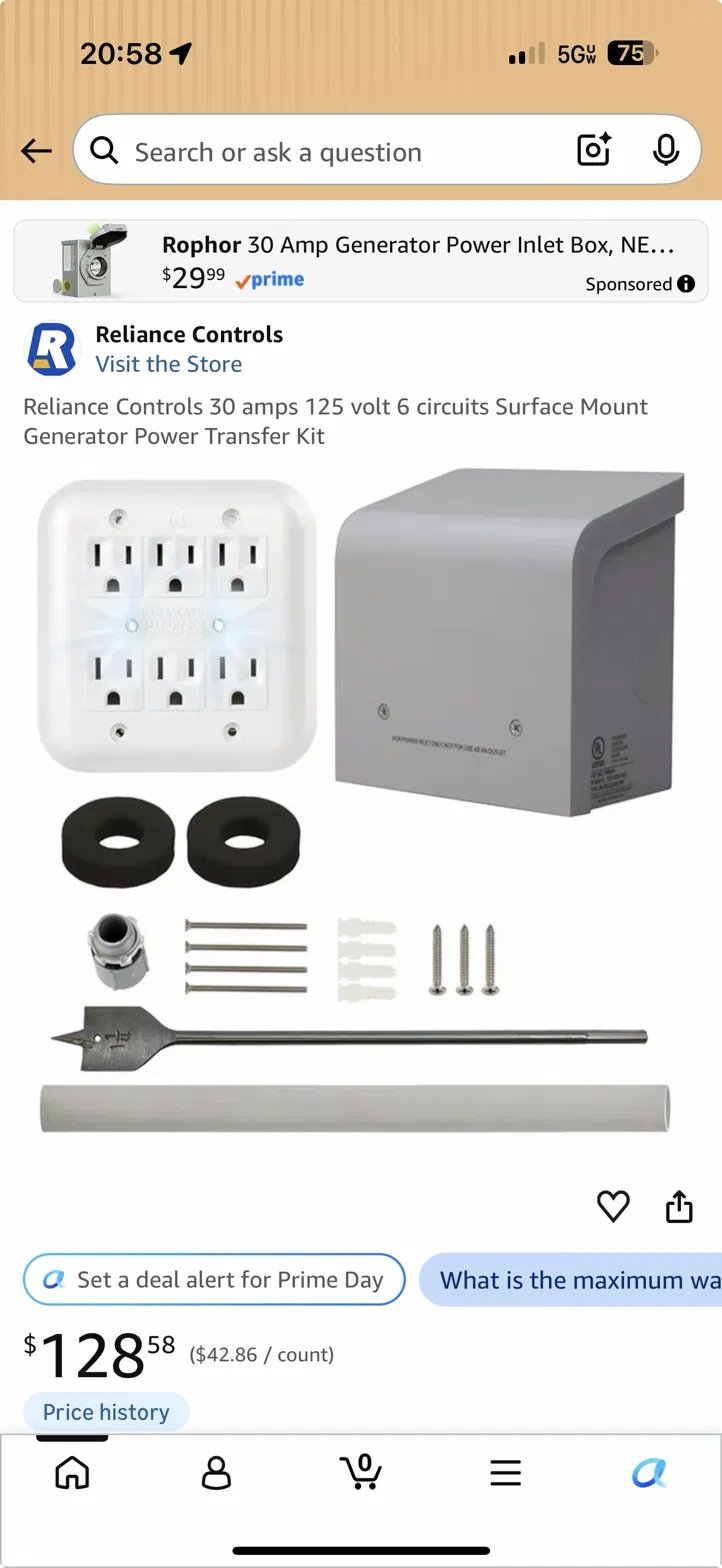
Reliance Controls Pro/Tran2 6-Circuit Transfer Switch
Connecting a portable generator to your home's electrical panel requires a UL-listed transfer switch — not an extension cord, not an informal hookup. The Reliance Controls Pro/Tran2 is one of the most widely used homeowner-friendly manual transfer switch kits. It's code-compliant, prevents dangerous backfeed onto utility lines, and satisfies the electrical inspector's requirements in most jurisdictions.
As an Amazon Associate, GeneratorPermitGuide earns from qualifying purchases. Disclosure